
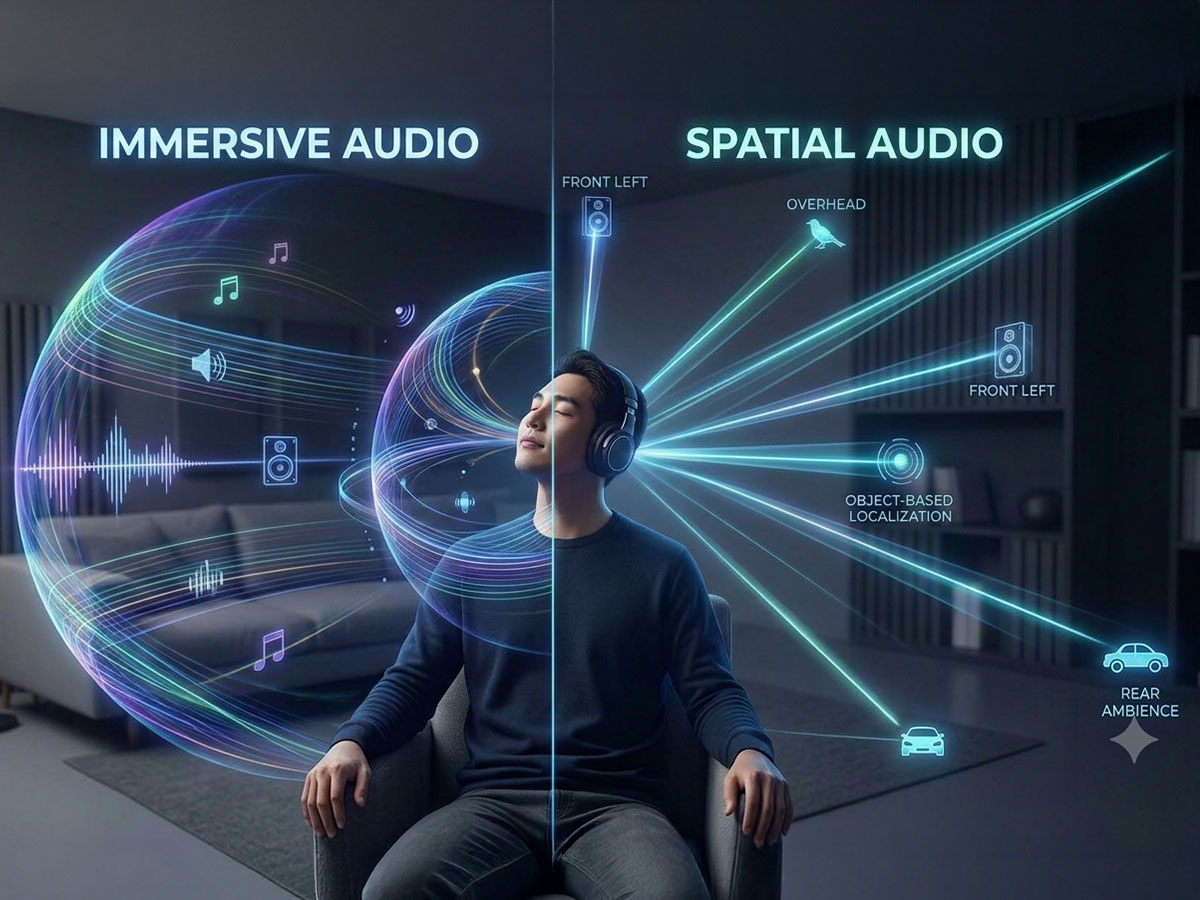
The terms immersive audio and spatial audio get used interchangeably all the time when talking about AV. However, while they are closely related, they are not the same thing.
The confusion is understandable, but we are here to clarify the meaning of these two words.
How We Hear
Human hearing is naturally three dimensional. We don’t just detect sound from our left or right side. We pinpoint it above, below, behind and in front. Our ears, the shape of our head and even the curve of the outer ear all work together to give us directional cues. Traditional stereo gives you two channels. Surround sound expands that to five or more speakers arranged around the listener. Audio is placed in a horizontal plane in both audio formats. In recent years, the change in the addition of height channels, which means speakers are mounted on the ceiling or overhead, which allows for sound to come from above you, not just around you. This shift from a flat horizontal ring of speakers to a full sphere, including the vertical dimension is what has enabled a completely different way of thinking about sound design.
Spatial Audio
Spatial audio is the technical umbrella. It is used to describe the technologies and methods used to position sound in a three dimensional space. Some examples of spatial audio formats are Dolby Atmos, DTS:X and Sony 360 Reality Audio. What they share is an object based approach, where each sound element carries metadata (these are essentially X, Y, Z coordinates) that tells the playback system where to place it. Instead of mixing sound to a fixed speaker channel, an audio engineer places it in a virtual space and the system figures out how to render it on whatever speakers are available.
For headphone playback, spatial audio uses head related transfer functions (HRTFs), which are mathematical models of how sound changes as it interacts with your head and ears before reaching your eardrums. This is how a pair of headphones can make sound seem like it is coming from all around you, even though the speakers are sitting directly in front of your ears.
Immersive Audio
Immersive audio describes the experience, not the technology. When sound surrounds you from all directions, and you are unable to find a fixed listening point, that is immersive audio. It is the result, and not the method.
For example, a well designed cinema with a Dolby Atmos system delivers an immersive audio experience. The technology that makes this possible is ‘Spatial Audio’. You can have spatial audio with full immersion too. This can be seen in a stereo headphone mix with basic HRTF processing. On the other hand, you cannot have truly immersive audio without some form of spatial processing behind it.
Why This Distinction Matters
In AV installations, the terminology matters as it shapes what gets specified and why. When a client asks for an “immersive audio experience”, they are talking about the outcome. To deliver that outcome, what spatial audio format and speaker configuration is chosen are separate decisions driven by room acoustics, budget and content type.
Spatial audio formats like Atmos are becoming increasingly accessible. Major streaming platforms support it too. DAWs like Logic Pro and Pro Tools handle Atmos natively. That means the gap between professional production environments and everyday listening has closed considerably. A mix made for theatrical Atmos setup can now be experienced on a soundbar or even just a pair of headphones, which adapts to the playback system in real time.
The terms will continue to blur in everyday conversations, and that is totally fine. However when you’re making decisions about systems, format or content, it is worth knowing which layer of the stack you’re actually talking about.