
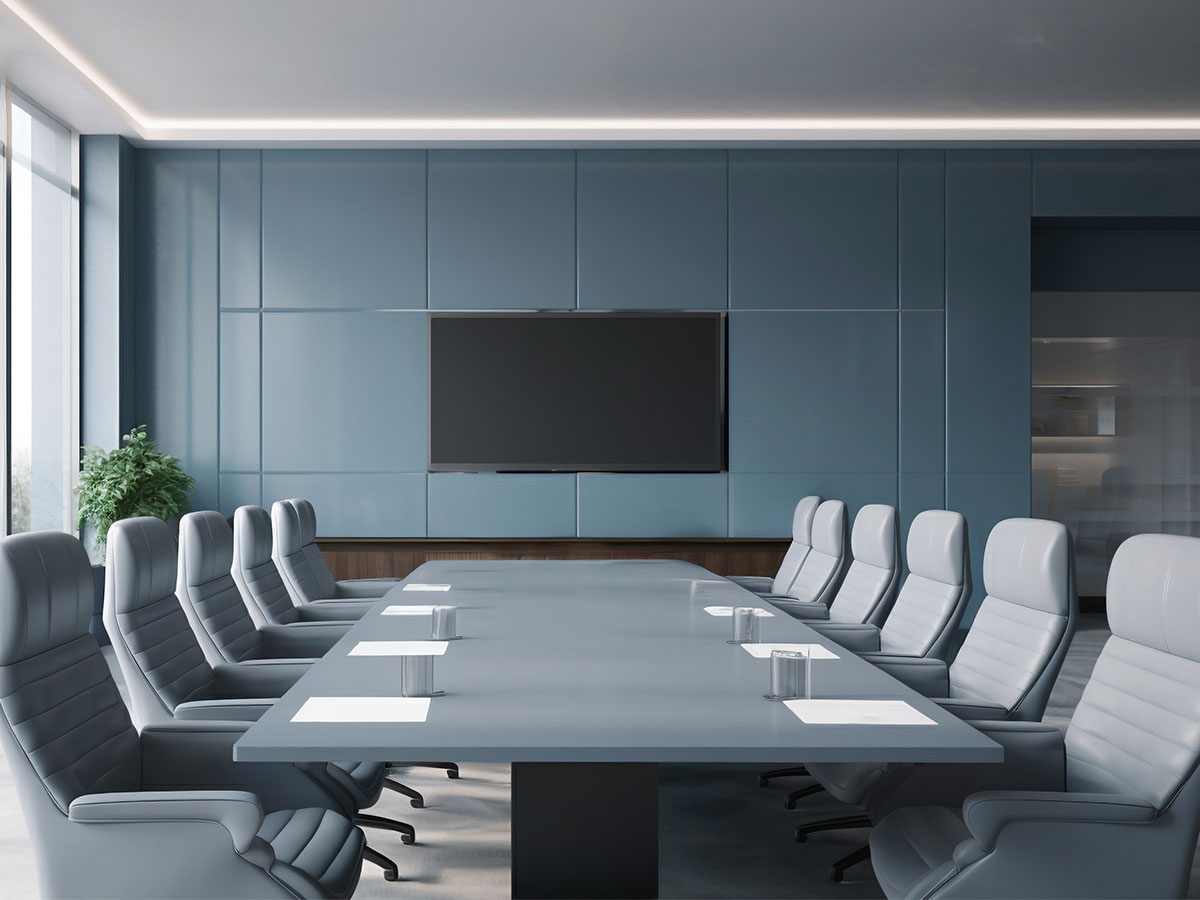
Think about the last meeting you had where something went wrong with the audio. It could be a participant who was unable to hear anything, the person at the far end of the conference room who was barely audible, or the room’s terrible echo that distorted your audio. During that meeting, you probably spent the first half an hour solely trying to fix issues instead of actually conducting the meeting.
Good AV technology solves these problems in the background, before the meeting even starts. Here are three products by Audio Technica that are worth knowing about:
Sound That Fills The Room With ATSP-30 Network Ceiling Speakers
Ceiling speakers have long been perceived in a certain way. They are associated with tiny and distant audio that works well enough for announcements, but is very inconvenient for meetings. Audio Technica’s ATSP-30 Network Ceiling Speakers are built to alter your expectations.
They sit at the level of the ceiling surface once installed and produce audio with a 140-degree coverage angle. The low-to-mid frequency reproduction is enough to handle not just voice amplification, but also video playback and background music, too. For small meeting rooms, the audio is full and natural, rather than that hollow sound that ceiling speakers usually produce.
The ATSP is part of Audio Technica’s LINK & Dante ecosystem, which connects to the ATDM SmartMixer and other devices over Cat5e cable, rather than complex analogue wiring. When it comes to multi-room installations, discrete audio signals can be sent to each speaker pair independently, so that different rooms can run different audios without any crossover. Once installed, all tuning is handled remotely through the ATDM mixer’s web interface, so adjustments don’t require actually climbing up to reach the hardware.
A Microphone That Knows Where To Listen: The ATND1061 Ceiling Tile Microphone
While speakers handle half the job, the other half is carried out by the microphone to ensure every voice in the room is actually being picked up. In a conference room with so many speakers around the table, a single directional microphone is always going to miss someone. On the other hand, omnidirectional microphones pick up everything, including the air conditioner. Audio Technica’s Ceiling Tile Microphone takes a completely different approach.
It sits in the ceiling and uses ‘beamforming’ to pick up specific voices. Beamforming is a way of focusing a microphone’s pickup in a certain direction, and makes sure that it doesn’t capture sound from everywhere at once. You can define coverage zones through the Digital Microphone Manager software, which allows the microphone to track speakers as they move within those zones. Certain zones can be prioritised, so that the presenter or chairperson gets precedence over the other participants. Similarly, one can also flag off certain areas as exclusion zones, like air conditioners or fans, so that the system isn’t constantly facing background interference.
The onboard processing handles echo cancellation, noise reduction, automix and gain control without needing an external DSP unit. Audio Technica’s voice activity detection technology distinguishes actual speech from ambient sounds, like paper shuffling, which keeps the automix focused on the right things. This product supports both single-cable and split-mode configurations for Dante-enabled installations, depending on the room’s infrastructure, giving integrators flexibility.
The Brain Behind The System: ATDM-1012 Digital SmartMixer
Speakers and microphones are only just a part of the story. What ties everything together is the ATDM-1012 Digital SmartMixer, the hub through which all audio is processed. It accepts up to 14 inputs, including microphones, line-level sources and USB audio. And then, it routes them across 12 independent output channels. Each input can be tuned individually, and the mixer supports four smart mixing groups that automatically manage levels, depending on who is speaking or what is playing in the background.
What sets the ATDM-1012 apart is how much processing it can handle under the hood. In environments where audio quality has to hold up regardless of what is happening in the room, features like echo cancellation, feedback suppression and dynamic level control can be applied across inputs and outputs as needed.
The control is pretty simple; basic adjustments can be made directly from the front panel with full configuration available through the Web Remote Manager or a standard browser over IP. For larger installations, up to eight ATDM devices can be linked together and the Dante-enabled ATDM-1012DAN extends that further with network audio support across the whole system.
To conclude, the three products work very well together because they are designed as a system. The speaker and microphone sit in the ceiling, invisible, while the mixer handles everything from a rack. All three can be connected over standard networking cables, which helps make installation easier and straightforward.
Audio Technica makes sure that the best technology in the room is the kind that nobody has to worry about.
Why is a DSP Essential?
Some installers attempt to compensate for room and system challenges using amplifiers and passive EQ. Sound adjustments can only go so far without signal processing. While an amplifier can change the sound and make sure it is heard, that system simply cannot provide the quality, resolution, or adjustability that a DSP offers.
The distinction matters enormously in professional environments. Whether it is a boardroom presentation, a university lecture hall, or a live performance venue, the goal is not just for the audience to hear the audio but to understand it clearly.
Choosing the Right DSP For Your Installation
The right DSP depends on the scale and complexity of your installation. Smaller conference rooms may need a compact unit with a handful of inputs and basic AEC, while larger venues require processors with more channels, advanced routing, and network audio capabilities.
Regardless of environment, integrating a properly configured DSP into your audio system is one of the highest-value decisions you can make. It is the component that turns a technically functional installation into one that genuinely serves the people using it every day.