
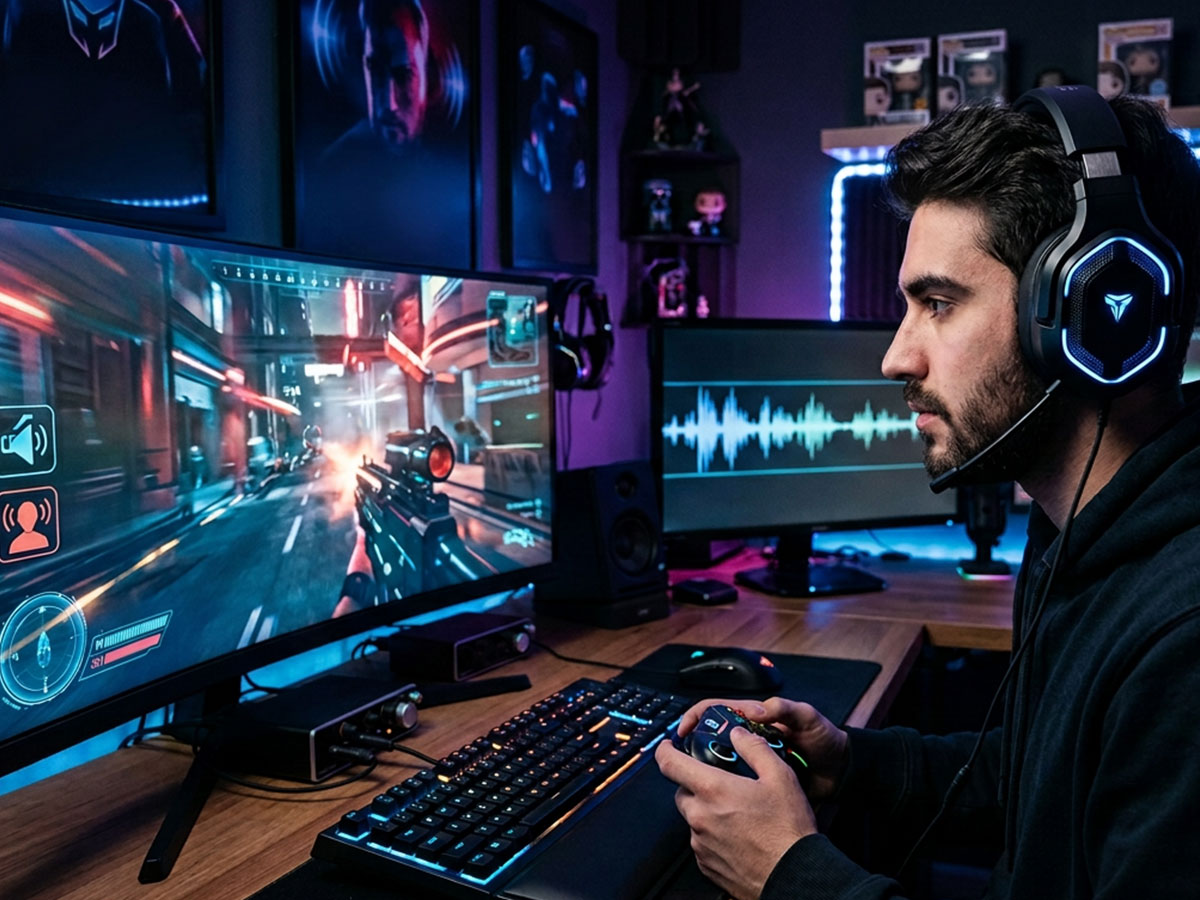
Imagine you are navigating a dark corridor in a horror game… You hear a faint noise, followed by footsteps that seem to be getting closer… You cannot see what is coming, but the sound alone is enough to alarm you…
In gaming, audio can be as important as what you can see on your screen. And with spatial audio, these moments become even more immersive, giving the sound a sense of direction, distance and depth.
So, what exactly is spatial audio and how does it work in gaming?
What Is Spatial Audio?
Traditionally, most headphones deliver sound through two channels: left and right. This is known as stereo audio. It allows you to hear the difference between sounds coming from your left and right sides, but it offers limited cues about where sounds are actually coming from.
This is exactly where spatial audio takes the listening experience one step further. Instead of simply separating sounds between the left and right channels, spatial audio uses digital processing to make sounds appear as though they are coming from specific locations around the listener. Depending on the technology and implementation, these sounds can appear in front of you, behind you, above you or at varying distances. Basically, spatial audio helps make a game’s world feel more realistic.
How Does Spatial Audio Work In Games?
Creating a convincing 3D sound experience goes beyond placing an audio effect in the left or right channel. Game audio systems combine several techniques to help the brain understand where a sound is coming from and how it interacts with its surroundings. Here are some of the key elements involved:
Directional Audio
The first step is determining the direction of a sound source relative to the player.
For example, if an opponent moves to your right, the game can adjust the audio so that the sound appears to come from that direction. As the opponent moves around you, the perceived position of the sound changes accordingly. However, simply making a sound louder in one ear than the other is only the beginning. To create a convincing three-dimensional effect, the audio system must also account for how humans naturally perceive sound.
HRTF: Head-Related Transfer Function
One of the technologies used in headphone-based spatial audio is called the Head-Related Transfer Function. Your brain does not locate sounds using volume alone. It also interprets tiny differences in the time a sound takes to reach each ear, differences in loudness and changes in the sound’s frequency caused by the shape of your head and outer ears. These cues help you distinguish whether a sound is coming from the front, behind you or somewhere above you.
HRTF-based processing uses digital filters to simulate how sound from different directions would interact with the listener’s head and ears before reaching the eardrums. This is what allows a pair of headphones to create the impression of sound moving around a three-dimensional space without requiring physical speakers positioned all around the room. A very interesting fact is that HRTFs can be as unique as fingerprints because everyone’s head and ear shapes are different. This is why some systems offer personalised spatial audio profiles to improve how accurately sounds are positioned for an individual listener.
Distance & Environmental Effects
Direction is only one part of the experience. Spatial audio can also communicate how far away a sound source is. In the real world, nearby sounds generally reach us more strongly than distant ones. The sound also changes depending on the environment and the surfaces it travels through. Game audio systems can reproduce these effects by adjusting volume, filtering certain frequencies and adding appropriate reflections or reverberation.
For example, footsteps approaching may become louder and clearer as the character gets closer. Footsteps heard from another room may sound quieter and more muffled. This is where techniques such as occlusion and reverberation become important. To put it simply, occlusion refers to the way an obstacle, like a closed door, blocks or reduces sound reaching the listener, while reverberation refers to the reflections of sound that continue after the original sound has been produced, similar to an echo. Together, these effects help communicate the layout and character of a virtual environment.
Why Is Spatial Audio Becoming Important in Gaming?
Spatial audio is not just an additional effect to make games sound more impressive; it influences how players interact with a game and respond to their surroundings. Listed below are some reasons why spatial audio is important in gaming:
Better Situational Awareness
In competitive gaming, knowing where an opponent is approaching from, whether a sound is coming from the same floor or another level or how close a threat might be can help players make faster decisions.
A More Immersive Gaming Experience
Immersion is one of the biggest reasons why spatial audio matters. A game can have detailed graphics and realistic environments, but if every sound seems to come from the same place, the world feels less convincing. Spatial audio helps connect what players see with what they hear.
More Effective Storytelling
Sound can communicate information that is not immediately visible on screen. Whether it is a voice coming from behind a closed door to suggest that another character is nearby, or footsteps fading into the distance to indicate that someone is leaving, spatial audio can use sound to establish a setting or guide the player through a moment.
Do You Need Special Headphones To Experience Spatial Audio?
One of the most common misconceptions about spatial audio is that it always requires an expensive gaming headset or a complicated surround sound setup. In reality, many spatial audio implementations can work through standard stereo headphones. The three-dimensional effect is created largely through audio processing, rather than by requiring a separate physical speaker for every direction. However, this does not mean that every pair of headphones will deliver the same result, as the experience depends on several factors, including the game’s audio engine, the spatial audio technology being used, the device’s compatibility and the quality of the headphones themselves.
If you are considering a spatial audio setup, here are a few things to keep in mind:-
Compatibility: Make sure your gaming platform, game and audio software support the spatial audio solution you want to use.
Sound clarity: Spatial positioning is only useful if you can clearly hear the sounds being reproduced. Headphones that deliver clear dialogue, footsteps and environmental details can make it easier to distinguish important audio cues.
Connection and processing: Check how your chosen device handles spatial audio and whether additional software or settings are required.
Conclusion
As gaming technology continues to evolve, spatial audio will only get more precise and responsive, adapting to players’ movements and virtual environments to make sound an even more integral part of designing games.